


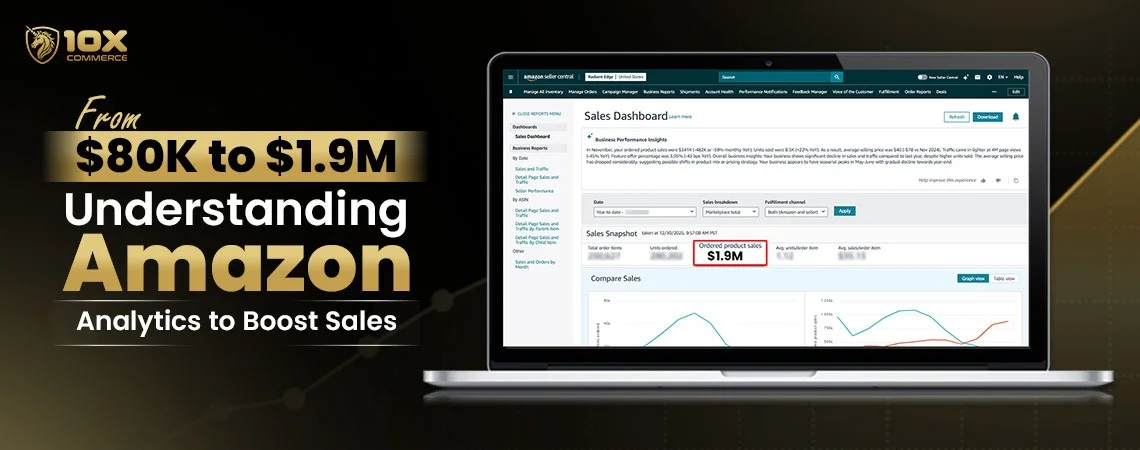
From $80K to $1.9M: Understanding Amazon Analytics to Boost Sales
Amazon analytics tools like brand analytics, business reports, and advertising reports give sellers access to data in detail on customer behaviour, search patterns, product performance, and buying decisions. These tools help sellers analyze buying behaviours to optimize listings, pricing, advertising, and product strategy based on real data, and play an important role in understanding Amazon analytics to boost your sales and improve overall business performance.
If these tools are used correctly, they become a decision-making system that can help you improve profitability, reduce wasted spending, and scale effectively. Sellers who are enrolled in the brand registry can get access to Amazon analytics tools for free.
At 10XCommerce, with years of experience working with Amazon brands, we know how to turn data insights from tools into measurable business outcomes. Our dedicated niche-specific experts work closely with sellers to interpret reports, identify opportunities, and design growth strategies. We have helped multiple brands scale into million-dollar businesses by turning complex data into approaches that drive consistent growth.
 Why Amazon Analytics Matters?
Many sellers check their sales numbers daily, but they just see:
- Orders are increasing or decreasing
- Ads spend rising
- Inventory moving
But they don't understand why things happen. Amazon analytics tools help sellers to analyze:
- Which products bring a good profit margin?
- Which keyword is converting?
- Which listings lose customers?
- Where is ad spend being wasted?
- When should inventory be restocked?
Understand Product Performance
The first step to scale is knowing which product is driving growth. Many sellers think their best-selling product is their most important one, but that's doesn't help always because:
Some products:
- Sell a lot but have low profit
- Require a heavy ad budget
- Have high return rates
Other products:
- Sell steadily
- Convert well
- Need less advertising
- Have strong profit margins
Amazon analytics helps identify profitable products vs busy products.
Key metrics to watch:
- Conversion rate
- Unit sold
- Revenue
- Profit margin
- Return rate
When sellers focus on the right products, apply the best Amazon PPC strategies for 2026, and check Amazon sales analytics carefully, growth becomes more stable.
Scaling from $80K to 200K starts with focusing on winning products.
Use Search Term Data Correctly
One of the biggest growth opportunities comes from search term data. Proper Amazon data analysis for sellers helps reveal what customers are searching for and how products appear in results.
Many sellers run ads but don't analyze the search terms inside Amazon analytics tools available in Seller Central. This leads to:
- Wasted ad spend
- Missed keywords
- Low conversions
Sellers who:
- Add converting keywords to listings
- Increase bids on profitable terms
- Remove bad keywords
- Create new campaigns based on real data
This helps them to improve organic ranking, improve ad performance, and support Amazon analytics to boost sales.
Track Conversion Rates
Traffic alone does not grow a business, conversions do.
Two sellers can get the same traffic but very different results.
For example:
| Seller A: | Seller B: |
|---|---|
| 1000 visitors | 1,000 visitors |
| 5% conversion | 12% conversion |
| 50 sales | 120 sales |
Both sellers have the same traffic, but the sales are more than double.
Common reasons of product not converting include:
- Low-quality images
- Weak titles
- Missing keywords
- Low review counts
- High pricing
- Poor A+ content
To improve conversion rates, sellers use Amazon creative design services, as CVR is the fastest way to increase revenue and improve sales performance.
Many sellers grow from $80K to $300K just by improving listing performance.
Monitor Advertising Efficiency
Advertising can help grow sales, but it can also harm profit margins.
Many sellers increase ad budgets when sales drop, but more spending heavily on ads doesn't mean more profit.
Amazon analytics helps track:
- ACOS
- ROAS
- Conversion rate
- Cost per click
- Sales by campaign
These Amazon performance metrics help sellers understand where advertising budgets are working and where money is being wasted.
Important insights include:
- Which campaigns are profitable
- Which campaigns waste money
- Which products depend too much on ads
After using insights from Amazon sales analytics, sellers who reduce ad spend and reinvest in profitable campaigns can drive measurable results, and some even jump from $300K to $800K in revenue.
Improve Inventory Planning
Running out of stock is very harmful to growth on Amazon. As,
When inventory runs out:
- Rankings drop
- Sales stop
- Ads pause
- Competitors take your place
- Buybox loss
- Account health issues (if sellers promote products that are out of stock, they get a violation, or in some cases, the account gets suspended.)
Amazon analytics helps predict:
- Monthly sales trends
- Seasonal demand
- Fast-moving products
- Slow inventory
Consistent tracking of Amazon sales performance gives sellers a plan to avoid unexpected stockouts. Stock availability is important for products with demand to scale to seven figures.
Understand Customer Behavior
Amazon analytics also reveals how customers behave. Through understanding Amazon Seller Central reports, sellers can identify buying patterns and customer preferences.
You can know:
- Which products do customers view together
- Which products do customers buy together
- Where customers drop off
- What customers prefer
This helps sellers:
- Create bundles
- Improve listings
- Launch better products
- Expand variations
Understanding the buying behaviour of customers helps sellers to apply Amazon analytics to boost sales through better decision-making.
Track Growth Trends
One mistake many sellers make is focusing only on daily sales.
Daily changes can be misleading.
Through analytics, you can track:
- Monthly growth
- Yearly trends
- Seasonal patterns
- Product life cycles
Regular review of Amazon sales analytics provides a clear picture of the long-term health of the business. Successful sellers track long-term performance instead of reacting to short-term fluctuations.
How to Check Amazon Sales Analytics to Boost Your Sales?
Here's how you can check:
Inside Seller Central:
- Click Reports
- Select business reports
- Open the detail page for sales and traffic by child item
This report helps with tracking Amazon sales performance, and understanding how to stay ahead of your competitors on Amazon sellers rely on these insights to monitor performance:
- Sessions (traffic)
- Conversion rate
- Units ordered
- Sales revenue
To check ad performance:
- Go to advertising
- Open campaign manager
- Download search term reports
If you are enrolled in Brand Registry, you can access Brand Analytics under the Brands tab.
This section provides Amazon data analysis for sellers to understand customer behaviour and competitor positioning, including:
- Top search terms
- Click share
- Conversion share
- Market basket analysis
Go to:
- Reports
- Select Inventory reports
Review:
- Sell-through rate
- Inventory age
- Restock recommendations
Challenges and Solutions with Amazon Analytics to Boost Sales
| Challenge | Solution |
|---|---|
| Amazon provides multiple reports inside Seller Central. Sellers see traffic numbers, sales reports, advertising dashboards, and inventory data, but don't know where to focus. | Start by identifying the Amazon performance metrics that impact growth, like:
|
| Many sellers track total sales daily and assume growth is happening if revenue increases. | Use Amazon sales analytics to track profit with revenue. Monitor advertising costs, product margins, and organic vs paid sales ratio. |
| Sellers view ads, sales, and inventory reports separately. This prevents seeing the full picture. | Combine insights. For example:
|
| Many sellers review reports but don't implement changes. | After every review, identify and refine at least one factor:
|
How did we help a seller scale?
The brand was generating consistent sales but was stuck at $80,000 annually. They were running ads and maintaining inventory, but the growth had plateaued. The seller felt they were doing everything right, but revenue wasn't increasing.
They were just reviewing sales numbers, but weren't analyzing insights from Amazon sales analytics. Without Amazon data analysis for sellers, decisions were based on assumptions instead of performance metrics.
These were the issues that were limiting growth:
- They were spending heavily on ads, and the return rate was inconsistent
- The visibility was poor on high-intent keywords
- Conversion rates were below the category average
- Frequent stockouts on best-selling SKUs
- There was no tracking of profitability at the product level
What we did:
- We conducted a full audit by using Amazon analytics tools that were inside Seller Central
- Then analyzed search term reports to identify profitable and wasted keywords
- Restructured advertising campaigns and reduced inefficient ad spend
- Our team of experts did Amazon listing optimization to refine product titles, bullet points, images, and A+ content
- Improved pricing strategy based on category-level Amazon performance metrics
- We built a plan for inventory forecasting with data to prevent stockouts
- The team focused on Amazon analytics to boost sales through consistent monitoring and adjustments
The Results
Within the first few months, advertising performance improved, and ACOS decreased. Conversion rates increased, and organic rankings strengthened because of keyword alignment. The growth was not driven by the launch of new products. It came from improving performance metrics and applying insights from Amazon analytics.
Over time:
- Their revenue scaled from $80K to 300K through Amazon PPC management campaigns and listing optimization
- Continued performance improvements pushed revenue beyond $800K
- With a sustainable data-driven strategy, we help them scale to $1.9M annually
FAQs
Products that sell fastest on Amazon are those that have consistent demand. Categories like everyday essentials, beauty products, kitchen tools, and trending seasonal items sell quickly because customers actively search for them with buying intent.
But, fast-selling does not mean that it will bring high profit. Some products sell quickly but require heavy advertising and have lower margins. This is where 10XCommerce helps brands make smarter decisions. The team analyzes Amazon analytics data such as search term performance, conversion rates, organic ranking, and product-level profitability to identify demand and scale sustainably.
By aligning listings with high-intent keywords, improving creative assets, optimizing pricing, and refining PPC strategy, 10XCommerce helps sellers focus on winning products that convert efficiently and grow organically. That is how sellers move from unpredictable sales to stable, high-performing revenue streams.
Sellers focus on revenue instead of profitability, increase ad budgets without analyzing ACOS, ROAS, and product margins, which reduces profit, and they run ads without reviewing search term reports, which leads to wasted spend on keywords that don't convert.
At 10XCommerce, we fix these issues through a data-driven approach. The team combines Amazon sales analytics, advertising reports, and inventory forecasting, and does listing optimization. Instead of reviewing reports separately, they connect the data points to analysis opportunities.
This approach has helped brands move beyond stagnant revenue, improve efficiency, and scale from $80K to multi-million-dollar businesses with consistent, sustainable growth.
Share this Post


Blog Categories
Uncategorized